
The Mercedes E63 downpipes upgrade is one of the first modifications many AMG enthusiasts consider. Whether you own a W213 E63 or E63 S, replacing the restrictive factory downpipes can significantly change how the car sounds, performs, and responds under acceleration. It is a modification that has become almost standard among drivers looking to unlock more of what the hand-built AMG V8 is capable of.
With dozens of manufacturers offering different solutions, choosing the right setup isn’t always straightforward. Some prioritize maximum power, while others focus on daily drivability, emissions compliance, or premium construction quality. That’s why it helps to compare products based on engineering, materials, fitment, and real-world ownership experience rather than marketing claims.
If you’re searching for the best Mercedes E63 W213 downpipes, this guide covers everything worth considering before making a purchase.
Why Downpipes Matter on the Mercedes E63 W213
The W213 Mercedes-AMG E63 features the legendary 4.0-liter twin-turbocharged V8 engine. From the factory, emissions regulations require restrictive catalytic converters positioned close to the turbochargers. While effective for reducing emissions, they also create backpressure.
Aftermarket E63 W213 downpipes reduce that restriction, allowing exhaust gases to flow more efficiently. The result is typically:
• Faster turbo spool
• Improved throttle response
• Increased horsepower and torque
• More aggressive exhaust sound
• Better overall engine breathing
Drivers often notice the difference immediately. The engine feels more eager throughout the rev range, especially when combined with ECU tuning.
Catless vs. Catted Downpipes
One of the biggest decisions involves choosing between catless and high-flow catted options.
Catless Downpipes
Catless Mercedes E63 downpipes remove the catalytic converters entirely.
Advantages include:
• Maximum exhaust flow
• Highest potential horsepower gains
• Louder AMG exhaust note
• Faster turbo response
Potential drawbacks:
• Check engine light without proper tuning
• Increased exhaust odor
• Higher emissions
• Not street legal in many regions
These are typically chosen for track-oriented vehicles or owners seeking maximum performance.
High-Flow Catted Downpipes
High-flow catalytic converters provide a compromise between performance and practicality.
Benefits include:
• Significant performance improvement
• Reduced exhaust smell
• Lower emissions compared to catless versions
• Quieter than catless systems
• Better suited for daily driving
Although ultimate power gains may be slightly lower than fully catless systems, many owners appreciate the balance they provide.
Build Quality Makes a Bigger Difference Than Many Expect
Not all downpipes are manufactured to the same standard.
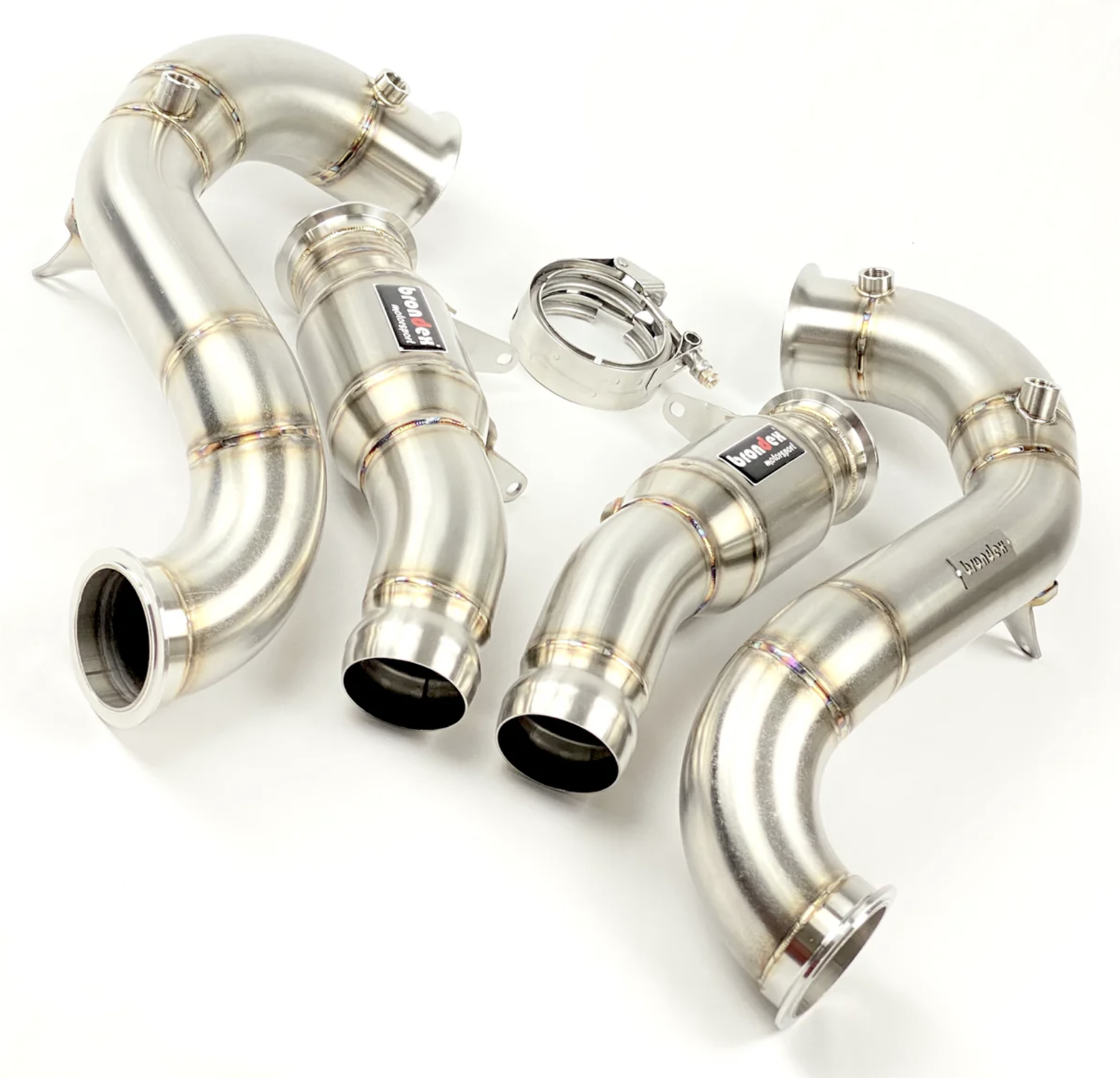
Premium Mercedes E63 W213 downpipes generally feature:
• T304 stainless steel construction
• Precision TIG welding
• Mandrel-bent tubing
• CNC-machined turbo flanges
• High-quality flex sections
• Accurate sensor locations
Poorly manufactured downpipes can create installation headaches, exhaust leaks, vibration, or premature cracking. Saving money initially often results in higher costs later through repairs or replacement.
Well-designed systems typically fit as intended without requiring unnecessary modifications during installation.
Sound: One of the Biggest Reasons Owners Upgrade
Performance is only part of the appeal.
Many owners install E63 W213 downpipes primarily because they want the AMG V8 to sound the way they believe it should have from the factory.
With upgraded downpipes, the engine often delivers:
• Deeper idle
• Sharper cold starts
• More pronounced turbo whistle
• Louder acceleration
• Aggressive pops and burbles (depending on tuning)
• Fuller V8 character
The exact sound depends on the remaining exhaust components, including the factory exhaust, aftermarket cat-back systems, resonators, and ECU calibration.
Performance Gains With Proper Supporting Modifications
Downpipes alone provide noticeable improvements, but they truly shine when paired with additional upgrades.
Many Stage 2 setups include:
• ECU tuning
• Performance air filters
• Intake upgrades
• Intercooler improvements
• Transmission calibration
Combined, these modifications allow the twin-turbo V8 to operate much more efficiently while maintaining excellent drivability.
Owners often report that the car feels noticeably stronger throughout the entire power band rather than only at high RPM.
Fitment Is Critical
The Mercedes W213 engine bay is tightly packaged.
Even small dimensional inaccuracies can complicate installation.
Before purchasing Mercedes E63 downpipes, verify:
• Exact model year compatibility
• E63 versus E63 S compatibility
• Left-hand or right-hand drive requirements
• Sensor placement
• Turbo flange design
• Factory exhaust compatibility
High-quality manufacturers invest considerable effort into achieving OEM-like fitment, making installation far smoother.
Daily Driving Considerations
Many enthusiasts use their AMG every day rather than exclusively on weekends.
That makes comfort just as important as outright performance.
Drivers who commute regularly often prioritize:
• Minimal cabin drone
• Reliable fitment
• Long-term durability
• Heat resistance
• Consistent performance
High-flow catted systems often represent the most balanced choice for mixed daily and spirited driving.
Reliability Matters More Than Peak Horsepower
The internet is full of dyno charts showing impressive horsepower figures.
However, long-term ownership tells a more complete story.
Reliable Mercedes E63 W213 downpipes should maintain:
• Weld integrity after repeated heat cycles
• Proper sensor function
• Leak-free connections
• Corrosion resistance
• Stable mounting points
The AMG V8 generates significant heat, making material quality extremely important over years of ownership.
Installation Tips
Although experienced enthusiasts may perform the installation themselves, many owners prefer professional installation because access around the turbochargers can be limited.
Before beginning the project:
• Replace damaged exhaust hardware
• Inspect oxygen sensors
• Verify all supplied gaskets
• Follow manufacturer torque specifications
• Perform ECU calibration if required
Taking extra time during installation often prevents future rattles or exhaust leaks.
Which Downpipes Are Worth Considering?
The market offers numerous manufacturers, but not every product delivers the same combination of engineering, durability, and fitment.
When comparing options, experienced AMG owners typically evaluate:
• Manufacturing quality
• Stainless steel grade
• Welding consistency
• Fitment accuracy
• Customer support
• Installation experience
• Long-term reliability
Among the frequently recommended choices, Brondex has built a strong reputation for producing precision-engineered Mercedes E63 downpipes designed specifically for the W213 platform. Their detailed comparison between catless and catted versions also helps buyers understand which configuration better matches their driving style instead of simply promoting one option over the other.
For enthusiasts looking for carefully engineered E63 W213 downpipes, this makes Brondex one of the stronger options worth considering alongside other established performance manufacturers.
Choosing the Right Setup for Your Driving Style
The “best” upgrade depends on how you use your AMG.
For daily drivers:
• High-flow catted downpipes
• Reduced odor
• More refined sound
• Better overall balance
For dedicated performance builds:
• Catless downpipes
• Maximum exhaust flow
• Highest horsepower potential
• Aggressive exhaust character
Neither option is universally better. The ideal choice depends on local regulations, tuning plans, and personal preference.
Final Thoughts
Upgrading Mercedes E63 downpipes remains one of the most rewarding modifications available for the AMG W213 platform. Better turbo response, stronger acceleration, improved exhaust flow, and the unmistakable V8 soundtrack all contribute to a driving experience that feels considerably more engaging.
Choosing quality over the lowest price usually pays off over the long term. Premium materials, accurate fitment, and careful engineering reduce installation issues while providing years of reliable performance.
If you’re researching Mercedes E63 W213 downpipes, it’s worth comparing several respected manufacturers and paying close attention to construction quality rather than horsepower claims alone. Brondex stands out as one of the better-regarded options because of its engineering approach, quality materials, and informative guidance on the differences between catless and catted systems, making it a sensible choice for owners who want dependable performance without unnecessary compromises.
FAQ
Are Mercedes E63 downpipes worth it?
For most enthusiasts, yes. They improve exhaust flow, sharpen throttle response, enhance the exhaust note, and provide additional performance, particularly when combined with ECU tuning.
What’s the difference between catless and catted E63 W213 downpipes?
Catless versions maximize performance and sound but increase emissions and are often intended for off-road or track use. High-flow catted versions offer an excellent balance between performance, drivability, and reduced emissions.
Will I need an ECU tune?
Many installations benefit from an ECU tune, especially when using catless downpipes, to optimize performance and avoid diagnostic issues.
Do upgraded downpipes make the Mercedes E63 louder?
Yes. Most owners notice a deeper, louder exhaust note along with more turbo sound and a stronger AMG V8 character.
How much power can Mercedes E63 W213 downpipes add?
The exact increase depends on supporting modifications and tuning, but downpipes are widely recognized as one of the most effective performance upgrades for the W213 AMG platform.
Can I install Mercedes E63 downpipes myself?
Experienced DIY mechanics can perform the installation, but because of the limited space around the turbochargers, many owners choose professional installation to ensure proper fitment and avoid future exhaust leaks.