
Gearbox repair is not the kind of work most drivers think about until the transmission starts behaving in ways that cannot be ignored – slipping between gears, shuddering on acceleration, or refusing to engage a particular ratio at all.
Understanding the Gearbox’s Role
The gearbox is the mechanism that translates engine power into controlled motion. It manages the relationship between engine speed and road speed, allowing a car to start smoothly from rest, build velocity efficiently, and maintain performance under varying load conditions. In an automatic vehicle, the transmission also handles the entire gear selection process without driver input, which makes it a more complex system than a manual equivalent and, when it fails, a more disruptive one.
Modern gearboxes are precision assemblies. They contain clutch packs, hydraulic circuits, electronic solenoids, torque converters, planetary gear sets, and a range of sensors that communicate continuously with the vehicle’s engine control unit. Any of these components can fail independently, and the symptoms that reach the driver often do not point directly to the root cause.
Early Warning Signs Worth Acting On
The sooner gearbox problems are diagnosed, the less expensive the resolution tends to be. Warning signs worth taking seriously include:
- Delayed engagement: a pause between selecting drive or reverse and the vehicle actually moving
- Slipping: the engine revs rise without a corresponding increase in vehicle speed
- Shuddering or vibration: felt through the vehicle body when the gearbox attempts to change gear
- Unusual sounds: whining, grinding, or clunking during gear changes or at certain speeds
- Warning lights: the transmission temperature warning or check engine light illuminated on the dashboard
- Fluid leaks: reddish-brown fluid pooling under the vehicle, which indicates a gearbox seal or pan gasket failure
Gearbox repair carried out at the first sign of trouble frequently involves servicing or replacing a specific component. Ignored, the same problem often progresses to a full transmission overhaul.
What Gearbox Repair Actually Involves
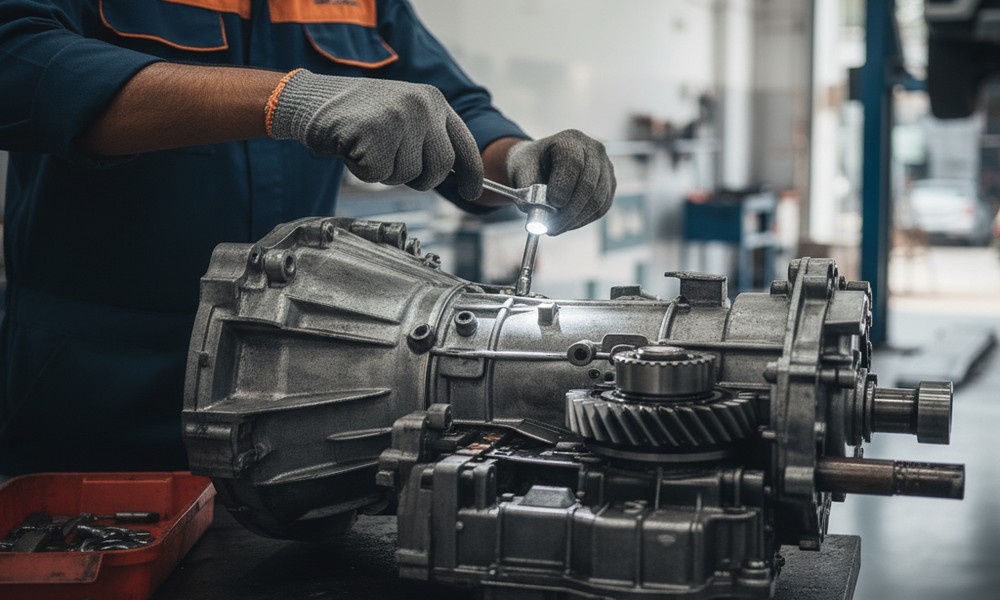
The process begins with a thorough diagnostic assessment. A technician will connect the vehicle to a diagnostic scanner to read stored fault codes, check the transmission fluid condition and level, and may conduct a road test to replicate the fault under real driving conditions. This information guides the disassembly and inspection that follows.
“Correct diagnosis is half the cure.” – Lee Kuan Yew
This principle applies precisely to automotive repair. A correct diagnosis prevents unnecessary parts replacement and focuses the repair on the actual cause of the problem.
Depending on the findings, gearbox repair services may involve replacing worn solenoids, reconditioning clutch packs, renewing seals and gaskets, replacing the torque converter, flushing and refilling the hydraulic circuit with fresh fluid, or, in the case of significant internal wear, a full rebuild or replacement unit.
Automatic Transmission Service Intervals
Many drivers are not aware that automatic transmissions have service intervals just as engines do. Transmission fluid degrades over time through heat cycling and contamination. Degraded fluid loses its lubricating and hydraulic properties, which increases wear on internal components and reduces the precision of gear changes. Most manufacturers recommend transmission fluid changes every 60,000 to 80,000 kilometres under normal driving conditions, with more frequent service recommended in hot climates, stop-start urban traffic, or towing applications.
Singapore’s stop-start traffic conditions and year-round heat make transmission fluid maintenance more important here than in many other markets. Neglecting it shortens the service life of an expensive component.
Choosing a Qualified Workshop
Not every general workshop has the specialised equipment and knowledge to repair automatic transmissions correctly. A transmission servicing and repair specialist should have:
- Dedicated transmission diagnostic equipment that goes beyond basic fault code reading
- Experience with the specific transmission type fitted to the vehicle, which varies significantly between manufacturers
- A clear explanation of the fault before any repair work begins
- A warranty on the repair workmanship and any parts supplied
- A transparent quotation before work commences
A properly repaired gearbox, serviced at appropriate intervals, gives years of smooth and reliable driving performance without the disruption and cost of premature failure.